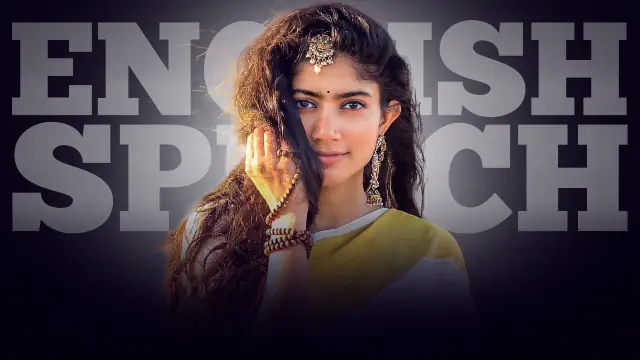
The Best of Sai Pallavi
Aamir sir, I can't say this is a dream come true because I've never imagined something like this. I didn't know it was possible. Because you've always been someone, you know, I imagine that you're in a different part of the world, and you're not reachable.
But today you're right there. I was actually two feet away from you so this feels surreal. And after coming into the industry, I've heard a lot of stories about you.
How disciplined you are and how you approach a character. And one such stories was this that I heard, and I was blown off. Apparently a few years ago you had to, be part of a commercial, for Coke, the Chhota Coke.
And your team had come over to, put up a presentation. And when they came over, they asked you to play a Hyderabadi panwala. And at that point, the presentation was over, and you said, "What kind of accent do you want me to, have?"
And then they said, "Sir, just Hyderabadi panwala." And you ended up saying there are six different types, and they ended up taking notes and going that day. I don't know if you remember, but one of the persons who was there, they told me this, and I was thinking, "Oh my God."
I always thought I was prepared before a particular role, but that's when I realized, oh, you no, that is not called preparation. You need to be this aware of it. So you've inspired us so much.
And I would, gladly or proudly say that all these days I was on the other side of, I was on the other side where I would listen to stories about you. So today I get lucky, and I go home, and I'll tell people I spent time with sir, and these are the stories I have to say.
So thank you so much for today, sir. It's an honor that we have you here. Thank you very much.
And Sai Pallavi, I know that you just spoke about rejecting a fairness cream, endorsement, and you said that you also felt like, you know, different from the rest of the entertainment industry. Do you wanna speak about how you came into the entertainment industry and why you felt different coming in? So firstly, it's just that we grow up seeing a lot of people who have perfect features, a perfect body.
Mm-hmm. So I always You meet these people by the way. On screen. On screen we see them, and then we feel that, oh, they're perfect. Excuse me, on screen you meet perfect Exactly.
And perfect creatures? Exactly. That is what we believe. Because she looks that beautiful, she looks that fair, she's got perfect features, we consider them to be actors and actresses.
Mm-hmm. So that's how I was. I grew up seeing, Trisha and Simran and all of them. They had perfect figure, they had great body.
But then there was one point at which I didn't know whether I wanted to become an actor, but there, I always had this insecurity when I was in Georgia doing medicine. So I was with these Georgians people who are very fair, and then they didn't have pimples, but I had all of this. And I didn't know whether I could accept this or accept myself for who I was.
And then I come back to India, and I'm so happy that Alphonse picked me for Premam. I was so nervous the day the movie got released. I was wondering, what if people abroad are gonna be there teasing me?
What are Aaga's gonna say? They're obviously gonna say I don't look like Simran, I don't look like Trisha, so this is gonna be bad news for me. And then I ended up seeing tweets after I went back to Georgia.
People were actually happy seeing someone in their own skin, and that made me feel so confident about myself. And then I wondered, okay, maybe that is all it is. Maybe if there's somebody up there, a lot of people will feel very happy about how they look.
So that is how I felt when I got into the industry. And I'm blessed that I worked with directors who liked me in my own skin, and they did have me put on makeup before, say, pre-shoot. But then they saw that it was not the real me, and I couldn't emote as much as I did without makeup, so they asked me to take it off.
So finally, this is where I am. And I'm personally very happy that I happen to be the one over here. Really. Really. Generally look at the whole population, and we think that there are a few people who are mocking at people of this color.
But honestly speaking, when I was in school and college, I grew up with friends who would look at a girl who had a darker boyfriend and say that, "Hey, you can actually do better. You're way out of his league." Mm-hmm. And when you see a guy with a girl who is a little darker, you end up saying, "I think there's something else this guy's.
What does, what does he see in this girl?" So we end up saying such things, and it's just nobody, no person who is there trying to make you feel bad. It's just us. We must have at some point of time passed that comment, and right now it's coming back to us.
It's just a boomerang. So when we start putting out positive, views about how we feel about others instead of pointing. And another thing is social media.
Mm-hmm. Right now, just because you have this curtain of anonymity, you end up writing whatever you want. You just say something when you're not in a very good mood, but the problem is it affects someone else somewhere else. So you have that power to actually create a change.
Come on, I just told you that I felt insecure. I didn't see any of you. But come on, few of you from here would have said something sweet about me, right, when the film released.
So I believed that, and I took it, and that's how I felt good. So I think it's just about, it's nobody else. It's not like the world is trying to bring you down.
You were there, and it can even be us. We were there at a very naive period, a very bad period where we said some wrong things. But it's time we change.
We know that it is possible for us to sin, but then it's important for us to consider or respect others' feelings and accept them for who they are. Yeah. Just look at their character and just fall in love. That is all. I'm 27 years old, and I haven't come across even one woman who hasn't been harassed, and that's a very sad thing.
But fortunately, everybody walks around putting on a smile and as if nothing even happened. It shows that we're much more stronger, and we think of this body as an instrument. But that does not mean that we shouldn't share our experience with another person, for two reasons.
One is that, you don't want the offender or the perpetrator to do this to another person, and you just want people around to be aware of it. And most of the time it's from our, say, by our relatives or someone whom we know. So it's a sad thing, again.
And secondly, by sharing this experience with another person whom you trust or whom you love, say mom, dad, friend, your spouse, anyone, you end up feeling a little bit liberated, a little bit better, I hope, and not as traumatic as you did. So these are two things that I wanted to mention.
But another thing was, apart from safety and asking for better punishment, for the perpetrators, I think it's important for us to, We are in a very beautiful time where we focus on equal pay, gender equality, and a lot of things. And I think it's important that we even stress on discipline.
It I know it's a word which you've learnt in school or in college, but honestly, it starts from home. It's simple, where you just notice how your children behave over a period of time, and you correct them. You can't put the burden on the society and on the cops, on the, on the, institutions that they are in for discipline.
Because once you teach your children how to be, you teach them humility, you teach them how to be humane, I think that will make the world a better place. You have to be better examples, I think. We can't Because the people whom we talk about are not some random people somewhere on some corner of the earth.
They are amongst us, and we ourselves, at some point of time, have been bad to another soul. But then we've moved on from that. It's because of what we've been learned, we've been taught from our childhood or what we've observed since our childhood.
How you treat your wife, and your kid sees how you treat your wife, and that's how it's going to the kid is going to grow up thinking, "Okay, that's how we treat a woman." How you how the kid, is exposed to an environment where, how they look at objectifying a woman, and that's how they end up thinking this is normal.
So it's important, I think, instead of looking for ways to, solve this problem, it has to start from within. Most of us are women over here, and I'm sure all of us will be great parents. But it's important for us to just not, say, copulate and just have children.
It's our responsibility. Instead of hoping for having a kid who is going to become the next big thing, going to be the best in their industry or field or whatever, it's important for us to make sure that they are not, a pain or some kind of a disturbance to themselves and the society. That is our responsibility. It's not like it's something which we have to do.
It is our duty, because you've brought in a being into this world. Make sure that it does not cause any harm, and leave it at that. It's okay. Whatever happens next is up to God and its own talent.
So thank you so much for this opportunity. I hope I could just connect with you all in a level that I could from my own experience. And thank you so much for whatever you've all done to make us feel safe.
Thank you so much again.