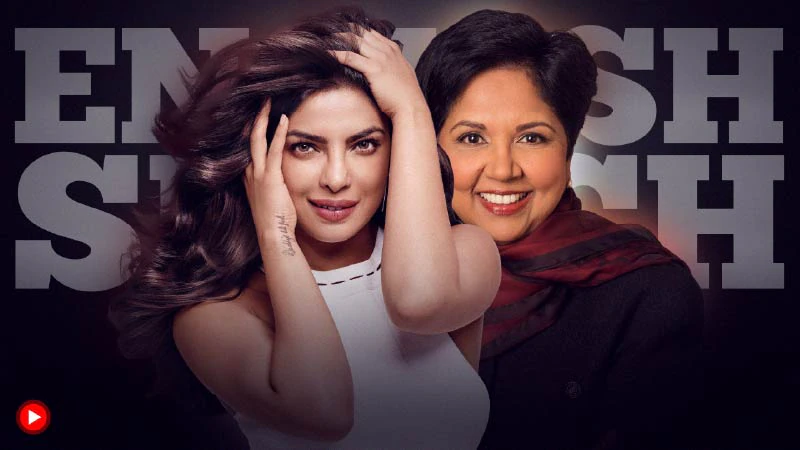
Powerful Indian Women
Priyanka Chopra: My mom, like ever since I was a kid, always told me, "You make the, you make mistakes, which all of us do. You might make wrong decisions, and you might be afraid to come and tell your parents, but courage of conviction is the only integrity that you need to have. Whether you make a mistake or not, whether you tell, you make good, bad, or ugly, it should all be yours."
Moira Forbes: I am so excited to be leading this conversation. Two women I admire, in many ways. And we also thought this couldn't be a more fitting way to close the summit.
Today's theme is all about leading the way forward, and these women have broken barriers. They've taken unconventional paths to success. They've built community in extraordinary ways, and across borders.
And many of you know who they are. They need no introduction. But just to put it in context in terms of the extraordinary power, influence, and success on stage, Indra Nooyi is a leader, who's at the helm of $150 billion company, leading PepsiCo'Whoo.
Yeah. Not a, not a small number. Nah. That's a lot of decimal points. And it's a lot of zeros, too.
Whoo. That's a lot of zeros. Leading a corporate family of over 260,000 employees around the world, and in her tenure, she's more than doubled the company's revenue while also aggressively diversifying, the company's product portfolio. Professionally, Priyanka, I would say it's also very difficult to sum up your job title in one line as well.
You're an actress, a Bollywood superstar, pop singer, star of the very popular show Quantico, a former Miss World, a movie producer, UNICEF goodwill ambassador, and activist. And you also have, Priyanka also has an extraordinary following of, close to or about probably 100 million people around the world who follow her across her social platforms.
So this gives you a sense of what influence and power looks like today, women who've defied limitations and who inspire others.
In our conversation as we close today, we'll hear about how their shared experiences have shaped their success, what are some of the common qualities that have united these career trajectories that are truly remarkable, and how they think about the impact that they have today, both professionally, but in terms of advancing the opportunities for future generations of leaders to emerge. So Indra and Priyanka, many thanks for joining me here today.
Thank you for having us. I wanna start off by, you know, going back to your childhood, which is something I did, with a speaker earlier today, because both of you have talked a lot about the influence of your parents, and your mothers in particular, on your career journeys in setting these formative values.
Indra, you grew up in a socially conservative city, and you described your mother as someone who was this interesting combination who would, who would adhere to traditional beliefs, never works or went to college, but she would always say to you, "I want you to get married when you're 18, and make sure you aspire to be the prime minister." Hmm. So this very interesting- which is good life goals to have.
Mm. Maybe not 18, but I'll take the prime minister part. But this, you know, that's an interesting juxtaposition, particularly coming from a woman who didn't work, who never went to college. Reflect a little bit about the values that she shared and those cultural roots that you've cited as so formative in threading the different experiences of your life together.
Indra Nooyi: Mara, thank you for having us here. It's great to be here with Priyanka, the beautiful and brilliant Priyanka. Aw. And I was just telling Priyanka, only one of those two adjectives apply to me.
You decide which one. How humble. But you know, interestingly, Mara, in retrospect, now we talk about my upbringing and talk about my mother and things like that. What she did and what we went through was very normal for when we were growing up in Madras in the south of India.
It was a conservative city, and every mother's dream was to get their daughter married off by age 18 or 20 at the latest, beyond which you were not quite marriageable. So, mothers in particular worried a lot about how are they going to make sure their daughters have a good marriage with a good family and get settled. And once you get settled, you can do whatever you want.
Can be prime minister, astronaut, do whatever you want. So it was get an education, preferably up to a master's, 'cause if you don't get a master's degree, families would sort of cringe. Mm-hmm. And get married to the right person.
And remember, I come from the nerdy south. I come from the nerdy south, too. My grandmother was Malayali, and she's a nurse.
Okay. So we both have aunts. I mean, everyone in my family's either a doctor or engineer. So we both come from a nerdy background, all right?
So it was if you don't, you don't have a master's degree and married by the time you're 20, you're in trouble. So when you come from that sort of a background, everything seems normal, 'cause she was behaving true to the role. I'm glad she behaved that way because, we got our master's degrees.
We studied hard. And then she allowed us to also fly because the men in our family said, "Hey, you're not gonna constrain the women." And I still remember this incident where, my sister got admission to a school outside, of our city, and she wanted to go away because it was very hard to get admission to the school.
And she got in, and she she wanted to go, and my mother said, "You can't go unless you get married." And my sister said, "What the hell? I've gotten admission into this very prestigious school.
I am under bond, and I don't wanna get married. I wanna go." My mom said, "If you go, I'm gonna fast until I die Okay? Which is very normal threats.
Indian moms, it's Indian moms, okay? It's, it's not even dramatic, it's normal. Very normal. So she started a fast, and my grandfather said to her, she told us kids, "It's okay if she dies, I'll take care of y'all."
And my father said the same thing, "It's okay if she dies, we'll take care of y'all, but you are going to school in Ahmedabad, and we've already paid the deposit." 24 hours later, my mother broke the fast. She's still alive. She's still alive.
And so I think it was, she was normal. I'm glad she was. So she was the brake, and my, the men in my family, my grandfather, my father, were the accelerator.
So combination made it work. Moira Forbes: And Priyanka, I wanna, turn to you because you said that you grew up with parents who were relatively progressive in the sense that they treated you and your brother, you said, equally or relatively equally. But I was really struck because your father, had a professional career, but your mother did as well.
She was, a double MD. She spoke, she speaks eight languages. Am I right? Eight languages.
My mother is a full overachiever. I mean, that isn't even overachiever. I mean, I can't even, like, think of eight languages here on the spot to name.
She has, I don't know if that, yeah, that doesn't, what that says about me, but you know, she has a business and the like.
How did that shape the way that you thought about your career in the sense that you had parents whose professional ambitions were very strong, and and rooted in a way that I would imagine was a little bit different, in the cultural context of some of your friends?
Priyanka Chopra: I think, first of all, I'm really excited to be here, and I am a big fan of not just Forbes, but of Indra, so I'm really happy to be on this panel, especially in a room full of female achievers. Y'all are all boss ladies, so thank you for being here. My upbringing really shaped me as a woman, as a person, because both my parents were super overachievers.
I mean, way to set your children up for failure. Both my mom is a double MD. She's a OBGYN and a ENT.
My dad was a surgeon, a musician, like a singer. He was also a composer and an artist. He used to paint.
And my mom spoke nine languages, is a licensed pilot, is, I forgot the pilot part. Yes. No. Like, of course. Of course she's a pilot.
It's like, "Of course you're a pilot." Yeah. Of course. She was like, "We didn't have TV then." you did. You just wanted to be an overachiever.
But both my parents were very progressive in their, in their mindsets, especially coming from a country at that time, which India was, which was a little bit like this, you know? A woman's life sort of ends when she gets married. Because after that, yeah, you can think about progressive families will tell Mm-hmm.
Yeah, you can achieve whatever, but your milestone is to get married. Whereas, my parents were. My mom even now says that, you know, because I'm in my 30s, obviously it's, like, way over the hill.
I should've been married, like, a decade ago. But my mother still says, she's like, "You know, you'll get married the day you find someone who will, who will appreciate how hard you have worked to get where you are, who will appreciate the sacrifices you made, and that's the man you will get married to. And if you don't, doesn't matter.
We're in the world of science. Can still have babies." And I was like, "What kind of mom says that?"
Mm-hmm, mm-hmm. But it was such a, but the idea was the philosophy behind it, that it didn't define me. And even my father, like my grandmother used to always say, "Oh my God, she's an actress. Oh my God, she can't even cook.
She'll never get married." And my dad was like, "Yeah, it's okay. I'll send a cook with her wherever she goes."
I was like, "Yeah, Daddy." And he was true till the day he died. Like, I had a cook with me that was preselected by my father because he knew I was particular about food, that he would sent with me wherever I went because he was like, "She can't cook."
Which is great for my figure, but probably not good for me. That's what I used to, I used to tell him that always, and he was like, "No." My parents had such a different way of thinking.
My mom, like, ever since I was a kid, always told me, "You make the, you make mistakes," which all of us do. You might make wrong decisions, and you might be afraid to come and tell your parents, but courage of conviction is the only integrity that you need to have. Whether you make a mistake or not, whether you tell, you make good, bad, or ugly, it should all be yours.
My dad, I was obsessed with Cinderella, like all kids are, with, like, fairytales and Disney and like, I was like, "Oh, I'm Cinderella." And I was a klutz as a child. Like, I couldn't walk straight without dropping something or breaking something or you know, breaking some bones.
And my dad used to call me Banderella instead of Cinderella. Now, bander in Hindi means monkey. And he used to say, "You're a Banderella."
And I used to get really offended. I was like, "Why would you call me a Banderella? I'm Cinderella. I could be pretty.
I could wear a gown. I could be Cinderella." He was like, "No, you drop shit around all the time."
"You know, somebody always has to be walking behind you so you don't break. You're a Banderella." So one day I got really offended, and we had this conversation, and I went up to him, like, you know, with all my, like, emotions in check. And I said, "Dad, it makes me feel really bad when you say Banderella."
So he sat me down for the first time, seriously explained it to me. He said, "Whatever you are and whatever you might want to be, that is the best version of you. So you drop stuff around, or you are a clumsy and you're a klutz, but it's you and that's what makes you special.
Why would you ever want to fit into some glass slipper?" And I was like, I didn't understand that. Me too. At nine.
I think I understood it at 15 when I knew what a glass ceiling was, 'cause he said, "You don't wanna fit into a glass slipper that someone has made for you that you need to fit into. You break the glass ceiling." And at 15, I was like, "Whoa, that's what that meant."
Until then I was like, "Where's the glass ceiling?" But it exists in such a big way, and that really shaped me. So, Things like that about my parents, coming from a country like that really shaped who I was Indra Nooyi: clearly an edit I just spoke to my mother, who's lives in Manhattan, and I said, "Mom, I'm going to do this panel with Priyanka."
And the first thing she said to me was, "Tell Priyanka to get married and settle down." The only thing she asked me to pass on to you. So if any of you know any single men that you wanna set Priyanka, we'll put a board Yes.
And you can just start, And if I'd stayed on the phone for two more minutes sending in information I your competition, you're right. No, if I'd stayed on the phone for two more minutes, she'd have recommended five guys that she found in some.
Moira Forbes: But but clearly culturally, there are these defining moments and expectations, that even when you are encouraged to think bigger and and beyond, there are these still, these moments such as marriage that are defining But I feel like, I feel like it's really not just a cultural thing.
I think women, like think about it, all the fairy tales, all the fairy tales we've always read end when the princess gets married. Why is there no story beyond that? That's the end of her life is, "Oh my God, she got the prince and she's married."
That's the next role you're gonna play. There we go. We've got your next movie. We've After she gets married, what happens?
But I think that brings up a good point just around these cultural narratives. But you know, you mention the words of courage and conviction and Indra, you you talked a lot about Indra Nooyi: it as well in terms of finding your passion.
I was really struck about your, journey to this country because you asked your parents for permission to study in America, and they were so sure that you wouldn't get a scholarship that they said, "Yes, apply. Go ahead" and you did, and you got in.
I'm curious, what about this country, what about the opportunity, what did you see in the world and your ambitions that you didn't see at home that you wanted to pursue in a way that many would see as very scary, and that unknown? Well, let's, first of all, we are a few generations apart, okay? She's, she's as old as one of my kids, so let's just be clear here.
When I grew up in India, we had no TV. We had no, cell phones, no internet of course. Going to the movie theater was like the biggest adventure for the family.
I mean, we planned months in advance to go see Sound of Music, okay? So life was very different. I mean, life was about going to school, coming home, studying, playing in the garden in the house, going back into the house.
So it was a very simple, uncomplicated life. Going to business school in India, studying in India is, was again uncomplicated because life didn't have as much as many distractions and as much of the social upheavals that my kids seem to be having in New York City today.
So given that, when I went to them and I said I wanna go to the States because everything we'd read about America was this was the dream country. Everybody was dreaming for a slice of Americana. Students who graduated from the best schools in India wanted to come to the United States because this was the best.
The colleges were the best. The universities were the best. Life here was spectacular.
So you sort of get caught up in that whole, spirit. And when I applied and got into Yale, my parents were so sure I wouldn't get any scholarship money, they said, "Of course you can go." And then when the scholarship and loan money came by and they were sort of in a dilemma, how do we send this young girl off to the States who's unmarried?
Because once she goes unmarried, she's not marriageable at all. Nobody will marry her because she's now gone alone to the States. So there was, there was a big family meeting.
Everybody got together. Should we send her or not? I was going. But then should we send her? You let them have their moment.
Oh, sure. The whole family had its meeting, and then they did something very interesting. They contacted all the friends of ours who'd already come to the United States and told all of them that they had to check up on me. So every week I'd have somebody come to Yale to check up on me, you know.
Is she all right? Is she running around with some guys? Is Were you?
Drinking, smoking. Were you? Were you? No, I'm just, I'm like I was the biggest nerd at Yale.
Is this the me you know now? God help. You know, I didn't make good use of my time at Yale, let's put it that way. And so I was, I was totally a nerd.
But you know, when they checked, Moira Forbes: they ticked off all the boxes, they said, "Okay, you can go now." But they set up a support system for me, and then the rest is history. That was 40 years ago.
I have, I have two questions to wrap up, before we finish the conversation. Each of you have broken barriers. Each of you serve as incredible role models around the world.
I would love for each of you to reflect on what the other, what the other woman on the stage represents in terms of opportunities for women. Priyanka, how do you see the work that Indra has done, as a role model for your generation, and what it means? And Indra, I would ask the same question to you.
I mean, there's really the one similarity between both Indra and I are we come from small towns, and we had big dreams, and we didn't let anything else define that. Priyanka Chopra: She's a proud woman who's an achiever who, the, and that, but that doesn't define her when she walks into a room.
She doesn't walk into a room like a lot of male CEOs do, you know, where you can tell by the sniff of their cologne how much of a CEO they are. And the hair gel. Yeah. And the hair gel too.
And the gel and the suit. Yeah. But Indra walks in, like she said, not just because of her brains, but for me as a girl who wants to be the biggest that I can be in whatever field that might be, she stands for integrity. She stands for being so self-assured that it's anything is like water off of a duck's back, you know?
She has this grace and charm and Mm. That she deals her life with. She's a mom. She's a, you know, daughter.
She's a wife, and she does all of that. I mean, I went for lunch at her house, and she cooked. I mean, I can't cook, so I really admire that about women.
And she cooked, like, from scratch, this Indian food, and like, she's completely wholesome. And I think when I like, as I'm growing up and as I see myself going forward in my life, I would wanna be a wholesome woman, and that's what I admire her for, is a wholesome woman. And Indra, what would you say, Oh.
What would you say about Priyanka? I'm smelling my cologne first 'cause Indra Nooyi: We know she can't cook, so you know, you can't, you can't, I gotta You can't say that. I gotta get this cologne.
But you know, I do I was thinking about clocks. I don't, you gotta. I don't think anybody comprehends how big a figure Priyanka is in India.
Mm-hmm. I mean, she's not normal. She's, like, awesome. Mm-hmm. Really awesome. When she walks, when she walks in the street, she'll get mobbed.
When she lands in the airport, it's, like, hundreds of people clamoring to see her. She's, like, hot stuff. And so,
You know, the amazing part about Priyanka is not only is she a fabulous actress, a fabulous dancer, fabulous musician, I'm sure many of you have never seen Bollywood films, but when you see her in one, it is spectacular. So most of her movies are, like, gross bestsellers. They just gross so much money.
But in addition to all of that, she's not one of these vacant, movie stars. She's a person with great intellectual, background. She's a person with enormous brains, aeronautical engineer who became an actress.
I mean, that's That's, those are usually not in the same sentence, right? Yeah. She's worried about humanitarian causes, social causes, is always coming forward to help people in need.
So I think, she represents one of the most progressive arms of moviedom, if you wanna call it that. And if people like Priyanka can lend their name and really lean in on these causes that change society like she's doing, the world will be a better place. So Priyanka, thank you for everything you do.
I think she's just awesome. Oh, well. Well, with that, I think that is a good place, a good place to end. I mean, I think it's.
Thank you to both of what you do. Moira Forbes: You give hope, you give possibility, you give inspiration to so many.
Mm-hmm. And I think it's a great reminder of, you know, I love where, Indra, when you talked about the power of the sisterhood and and needing to, free ourselves from some of the boxes and constructs that others put us in, and have a sense of confidence and self-assurance.
Because within that and in that, is where real opportunity for our strengths to come to play, happen. So again, I wanna thank you to two amazing women. Thank you. Thank you.
And Thank you. Whose power is extraordinary, Thank you all. And whose gifts are extraordinary.
Thank you. So thank you ladies. Thank you. Thank you very much. Thank you.