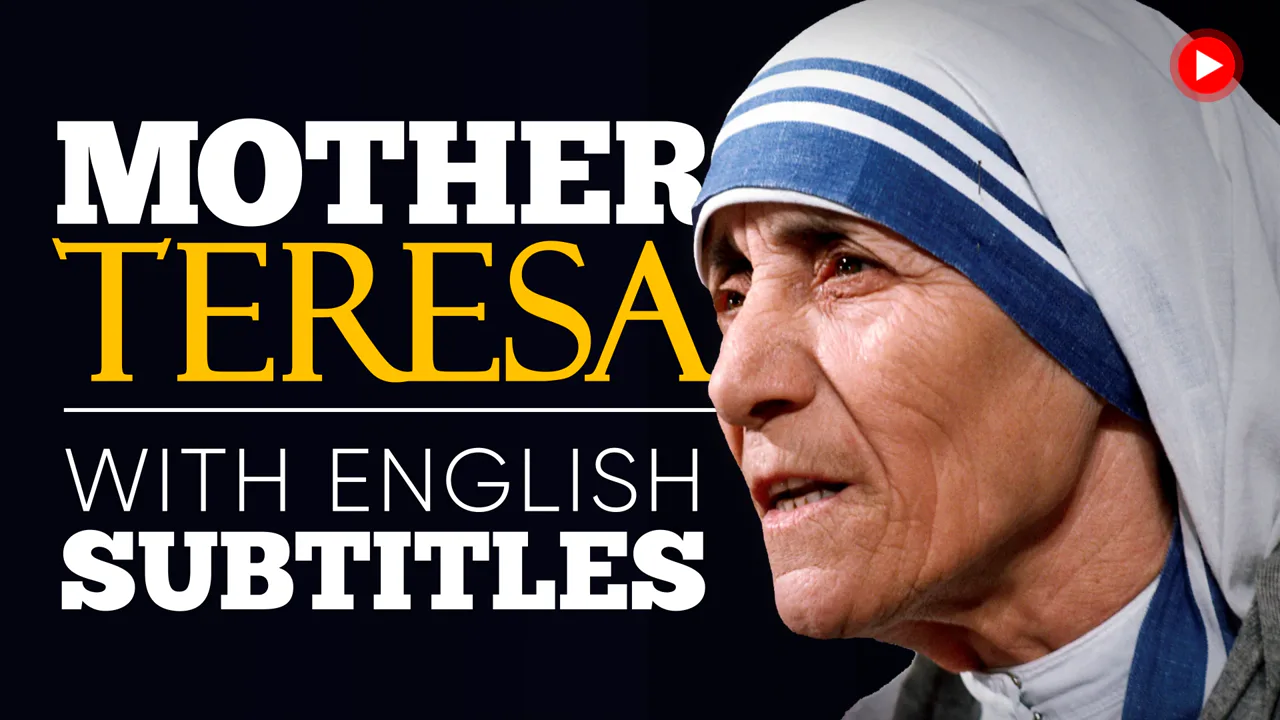
Nobel Peace Prize Speech
Let us all together thank God for this beautiful occasion where we can all together proclaim the joy of spreading peace, the joy of loving one another, and the joy acknowledging that the poorest of the poor are our brothers and sisters. As we have gathered here to thank God for this gift of peace, I have given you all the prayer for peace that St. Francis of Assisi prayed many years ago.
And I wonder, he must have felt and been what we feel today to pray for. I think you have all got a. With you. We'll say it together.
Lord, make me a channel of Your peace. That where there is hatred, I may bring love. That where there is wrong, I may bring the spirit of forgiveness.
That where there is discord, I may bring harmony. That where there is error, I may bring truth. That where there is doubt, I may bring faith.
That where there is despair, I may bring hope. That where there are shadows, I may bring light. That where there is sadness, I may bring joy.
Lord, grant that I may seek rather to comfort than to be comforted, to understand than to be understood, to love than to be loved. For it is by forgetting self that one finds. It is by forgiving that one is forgiven.
It is by dying that one awakens to eternal life. Amen. God loved the world so much that He gave His Son. And He gave Him to a virgin, the Blessed Virgin Mary.
And she the moment He came in her life, went in haste to give Him to others. And what did she do there? She did the work of the handmaid.
Just serve. Just spread that joy of loving through service. And Jesus Christ loved you and loved me, and He gave His life for us. And as if that was not enough for Him, He kept on saying, "Love as I have loved you as I love you now."
And how do we have to love? To love in the giving, for He gave His life for us, and He keeps on giving. And He keeps on giving right here, everywhere, in our own lives and in the lives of others.
It was not enough for Him to die for us. He wanted that we love one another, that we see Him in each other. That's why He said, "Blessed are the clean of heart, for they shall see God."
And to make sure that we understand what He means, He said that the hour of death we are going to be judged on what we have been to the poor, to the hungry, to the naked, to the homeless. And He makes Himself that hungry one, that naked one, that homeless one. Not only hungry for bread, but hungry for love.
Not only naked for a piece of cloth, but naked with that, of that human dignity. Not only homeless for a room to live, but homeless for that being forgotten, being unloved, uncared, being nobody to nobody. Having forgotten what is human love, what is human touch, what is to be loved by somebody.
And He says, "Whatever you did to the least of these my brethren, you did it to me." It is so beautiful for us to become holy through this love. For holiness is not the luxury of the few.
It is a simple duty for each one of us. And through this love we can become holy. Through this love for one another.
And today, when I have received this award, I personally am most unworthy. And I having a vow of poverty To be able to understand the poor, I choose the poverty of our poor people. But I am grateful, and I'm very happy to receive it in the name of the hungry, of the naked, of the homeless, of the crippled, of the blind, of the lepers.
Of all those people who feel unwanted, unloved, uncared, throwaway of the society. People who have become a burden to the society and are shunned by everybody. In their name, I accept the award, and I'm sure this award is going to bring an understanding love between the rich and the poor.
And this is what Jesus has insisted so much. That's why Jesus came on earth, to proclaim the good news to the poor.
And through this award, and through all of us gathered here together, we are wanting to proclaim the good news to the poor, that God loves them, that we love them, that they are somebody to us, that they too have been created by the same loving hand of God to love and to be loved. Our poor people are great people, are very lovable people. They don't need our pity and sympathy.
They need our understanding love. They need our respect. They need that we treat them with dignity.
And I think this is the greatest poverty that we experience, that we have in front of them who may be dying for a piece of bread. But they die with such dignity. I'll never forget when I brought a man from the street.
He was covered with maggots. His face was the only place that was clean. And yet that man, when we brought him to our home for the dying, he said just one sentence, "I have lived like an animal in the street, but I'm going to die like an angel, loved and cared."
And he died beautifully. He went home to God, for death is nothing but going home to God. And he having enjoyed that love, that being wanted, that being loved, being somebody to somebody at the last moment, brought that joy in his life.
And I feel one thing I want to share with you all. The greatest destroyer of peace today is the cry of the innocent unborn child. For if a mother can murder her own child in her own womb, what is left for you and for me to kill each other?
Even in the scripture, it is written, "Even if mother could forget her child, I will not forget you. I have carved you in the palm of my hand." Even if mother could forget.
But today, millions of unborn children are being killed, and we say nothing. In the newspapers, you read numbers of this one and that one being killed, this being destroyed. But nobody speaks of the millions of little ones who have been, have been conceived with the same life as you and I with the life of God.
And we say nothing. We allow it. To me, the nations who have legalized abortion, they are the poorest nation. They are afraid of little one.
They are afraid of the unborn child, and the child must die because they don't want to feed one more child, to educate one more child. The child must die. And here I ask you in the name of these little ones, for it was that unborn child that recognized the presence of Jesus when Mary came to visit Elizabeth, her cousin.
As we read in the gospel, the moment Mary came into the house, the little one in the womb of his mother leaped with joy, recognized the Prince of Peace. And so today, let us here make a strong resolution. We are going to save every little child, every unborn child.
Give them a chance to be born. And what we are doing, we are fighting abortion by adoption. And the good God has blessed the work so beautifully that we have saved thousands of children.
And thousands of children have found a home where they are loved, they are wanted, they are cared. We have brought so much joy in the homes where there was not a child.
And so today, I ask, since His Majesty is here, and the, before you all who come from different countries, let us all pray that we have the courage to stand by the unborn child, and give the child an opportunity to love and to be loved. And I think with God's grace, we will be able to bring peace in the world. We have an opportunity.
Here in Norway, you are, with God's blessing, you are well-to-do. You are. But I'm sure in the families, many of our homes, maybe we are not hungry for a piece of bread, but maybe there is somebody there in the family who is unwanted, unloved, uncared, forgotten. There is love. Love begins at home.
And love, to be true, has to hurt. I'll never forget the little child who taught me a very beautiful lesson. They heard in Calcutta, the children, that Mother Teresa has no sugar for her children.
And this little one, Hindu boy, four years old, he went home and he told his parents, "I will not eat sugar for three days. I will give my sugar to Mother Teresa." How much a little child can give.
After three days, they brought him to our house. And there was this little one who could scarcely pronounce my name. He loved with great love.
He loved until it hurt. And this is what I bring before you to love one another until it hurts. But don't forget that there are many children, many children, many male and women, who haven't got what you have.
And remember to love them until it hurts. Some time ago, this to you will sound very strange, but I brought a girl child from the street. And I could see in the face of the child that the child was hungry.
God knows how many days she had not eaten. So I gave her a piece of bread. And the little one started eating the bread crumb by crumb.
And I s. "Eat," I said to the child, "Eat the bread. Eat the bread." And she looked at me and said, "I'm afraid to eat the bread because I'm afraid when it is finished, I will be hungry again." This is a reality, and yet there is that greatness of the poor.
One evening, a gentleman came to our house and said, "There is a Hindu family with eight children, have not eaten for a long time. Do something for them." And I took rice and I went immediately.
And there was this mother, and those little ones' faces, shining eyes from sheer hunger. She took the rice from my hands. She divided it into two, and she went out.
When she came back, I asked her, "Where did you go? What did you do?" And one answer she gave me, "They are hungry also."
She knew that the next-door neighbor, a Muslim family, was hungry. What surprised me most, not that she gave the rice, but what surprised me most, that in her suffering, in her hunger, she knew that somebody else was hungry. And she had the courage to share, and she had the love to share.
And this is what I'm. I want you to love the poor. And never turn your back to the poor, for in turning your back to the poor, you are turning it to Christ.
For He had made Himself the hungry one, the naked one, the homeless one, so that you and I have an opportunity to love Him. Because where is God? How can we love God?
It's not enough to say, "My God, I love you." But "My God, I love you. Here, I can enjoy this, but I give up.
I could eat that sugar, but I give that sugar." If I stay here the whole day and the whole night, you would be surprised of the beautiful things that people do to share the joy of giving. And so my prayer for you is that through we bring prayer in our homes.
And from the fruit of prayer will be that we believe that in the poor, it is Christ. And if we really believe, we will begin to love. And if we love, naturally we will try to do something.
First in our own home, next-door neighbor, in the country we live, in the whole world. And let us all join in that one prayer, "God, give us courage to protect the unborn child, for the child is the greatest gift of God to a family, to a nation, and to the whole world." God bless you.