Women's Empowerment
I think, the first thing when I came to know that I'll be speaking over here is that I was actually cursing my stars because I know nothing about economics. I'm a science student, so I'll introduce myself. So, you all know my name.
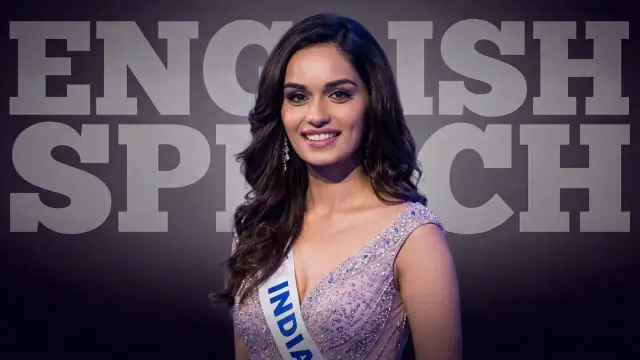
I'm Manushi, and I come from a family of doctors, and I'm studying to be a doctor as well. I'm 20 right now, and I have been honored to be your Miss World for this year and carry out her duties. So, growing up, I had a very normal childhood, like any, Indian girl from a middle class family would have.
I got my education, I had my siblings. And then suddenly overnight my life changed, and now I'm here. So we just had, a panel about women entrepreneurs, and I know the word entrepreneurs sounds scary, because you start thinking about all, about all business, which is something I don't understand.
But I think being Miss World and being an entrepreneur is quite similar because you have similar goals. You wanna bring change. I think change is something which is,
To me, it's synonymous with being an entrepreneur. You love what you do and you love risks, and being a Miss World is definitely about taking risks. Like, I came up here to speak in front of you which is a very big risk for me.
But I think most importantly, we don't let other people tell us how we're supposed to work or how things should be done. We take our own decisions, and I think all those entrepreneurs out there must congratulate themselves because it, because it takes a lot of courage to do that. Women are doing wonders as entrepreneurs.
You recently I read in Kerala about, a system called Food On Wheels, for it was providing employment to women, so they would provide tiffins and nutritious food, to people who wanted to work. But you know, out of all these wonderful entrepreneurs, I think one such wonderful woman is my mother. It's, it's not hidden from the world how much obsessed I am with her.
We all are with our mothers. But I believe that all mothers are entrepreneurs. And I did look up, I'll be very honest, I looked up the definition of an entrepreneur on Google.
We have, we have the head of Google here, right? So, just on stage.
So, I looked it up on Google and I realized that being a mother is very similar to being an entrepreneur because you set up a system which is a family, and you invest, you take risks, and you actually have the most important job of rearing up the future of, not your family or not of an individual, but of the entire world, and that is a very tough and a very risky job to do.
So for me, all mothers are entrepreneurs. On the Miss World stage, in my, in my top five round, I remember when I was. I didn't know what was happening that day.
It just felt like another rehearsal to me. And the moment I reached to top 10, that is when I saw, I saw my parents, I saw my family in the crowd because I was trying to spot them the whole while, and they were, they were coming down to give an interview. And at that moment I knew it.
I knew I was gonna do something great tonight. And the moment I reached to top five, I remember someone telling me that, "You know, it's, it's all right what happens tonight. Don't be nervous because you've come to top five and you've made history.
You are the top five in Miss World Twenty Seventeen," which is a big thing because, coming from a girl who, like, being a girl who never really, wore heels or who never knew how to even apply an eyeliner, it was a very big deal for me to be out there.
But the moment I saw my parents and I saw how proud they were of me, I knew that even if I don't walk out with a crown, I knew I was gonna, I was gonna be a winner tonight. And that's, that's how my answer, my answer came at that moment.
And believe me, had you asked me anything, even if you would have asked me who's the president of India, I would have said mom, because I was so emotional that time. But definitely mothers do deserve the high salaries, because like I just said, you know, they are.
I remember one thing from my economics book is that humans are the largest resource, and I mean, mothers are taking care of that resource of the largest capital any country can have, which is human capital. So, going away from that, I think, we all know for me, my mother is a superwoman, and she's a working mom. She's a neurochemist, so very disciplined in life.
But at the same time, she's the most compassionate, the kindest woman that I've ever known. She's, she's not only my mom, she's my best friend. She is my role model.
She's someone I've looked up to growing up and she's, she's my guardian angel, my Durga Ma, I call her. And I know that irrespective. She lets me take decisions.
She lets me make all kinds of mistakes. And when I come home, I know that even if, I might not at that moment think that I won. I for that moment, I might think it's a failure, but you know, she's, she's there for me when I come back home.
It's not easy when you have two worlds to balance because I'm very proud to say that she has done amazing as a doctor. She's an amazing doctor, but at the same time, she's never made me feel like she didn't have the time for me, or she's, she's always been there for me as a mother.
And this is something that a lot of women out there, all the women here have been doing who are mothers as well. And that is something that has always amazed me as a child that, I mean, I don't know how you can balance two wonderful things so perfectly without even having a hint of worry on your face.
Having said this, I think, I feel that aren't women already the most powerful? They're entrepreneurs. They're, they're, they're creating the future of the country, so they're, they're already the most powerful, and when it comes to women empowerment, I think they must realize that they have such a big responsibility, which they're doing kickass, like complete pros at. They're complete pros at it.
So aren't they already empowered? Well, for me, as, for me, women empowerment weren't actually two words which, I knew a lot about because I never, I never felt that I needed to be empowered. But growing up, I come from a, from the state of Haryana.
I've I had never stayed there till I went to college, and I chose to educate myself at a college which is a girls college in rural Haryana because I believed something that my father told me that if you go to the remotest of places, as a doctor, you will learn the most, and I wanted to learn.
But when I went to my college, it was completely different from what I had imagined. And that's when, as an 18-year-old, I had an idea to do something when it came to menstruation.
Because, at that point of time, all I understood was health, and I felt that, well, menstruation, if, women are more comfortable about menstruation and you know, they'll be able to take care of their hygiene, then definitely it won't boil down to diseases such as pelvic inflammatory diseases and your RTIs, and that could. RTI, reproductive tract infection, not the RTI you guys, know.
So that's how I started my project. And so in the local areas, they started calling it as Shakti when I would go because, I mean, Shakti, you all know that every woman is supposed, is considered as a, as a form of Shakti, and Shakti means power and to empower, and that's, that's how more than just a health project, it became an empowerment project for me.
I showed the project to the Miss India team. They really liked it. It wasn't a project at that time.
It was just an idea. I was doing awareness, programs with the help of my parents. But after winning Miss India, you have something called as Beauty with a Purpose at Miss World.
Beauty with a Purpose is the vision and mission of Miss World. That's what Miss World stands for. It gives young girls like me, not just me, but all 130 countries that represent at Miss World an opportunity to bring a change in their country or in their communities.
And well, Miss India wanted to work on my project, so, I worked across three states in North India, more than 20 village communities, and we created women entrepreneurs. So entrepreneurs back in. So, we encouraged women from the village to source sanitary pads from the Walmart.
So I collaborated with Walmart India and a local manufacturer of sanitary pads. And so these womens would purchase low-cost sanitary pads and sell them in their village because more than the lack of awareness and the high cost of sanitary pads which, women felt, it was, it was the taboo that was associated with it. And women would feel, uncomfortable to buy sanitary pads from mostly a man who's a shopkeeper.
So that's how. That was my short-term project. I remember being shortlisted as a semifinalist for Beauty with a Purpose at Miss World, which is the biggest award, when you go for a Miss World competition.
And I was looking at my project. Three and a half months I traveled, across those states. It wasn't easy to go to these places.
I went, I went to a village where children didn't even have clothes to wear. So I could imagine that if they can't afford proper clothes, how can they afford sanitary pads? I mean, that's, that's the kind of mentality that they have over there.
And as a 20-year-old, to see so much, it just makes you want to do so much more because I'm still growing. I'm still learning. I'm still in that stage where I'm figuring out what I truly want to do in life, and that's when I found my purpose. And in the top 20, there were amazing projects.
But when I saw my project come up, I had tears in my eyes because I couldn't believe that I had done it, of course, with the help of a huge team, and I won Beauty with a Purpose, and I'm very proud to say And I'm very proud to say that I'm the first Miss World who also won Beauty with a Purpose.
After which, of course, not only my project, after winning Miss World, we were here in India. This year's Beauty With a Purpose tour started from my home country, from my project, where we traveled for nine days. Not only me and the Miss World team, but we had continental winners.
We had young girls. So they weren't, they aren't politicians, they aren't powerful people, but they are just young girls just like me. They're students, they're daughters.
One of them is in, still in school. And they all came down, and we all were traveling across India trying to spread awareness, trying to create, different systems. We met with, people called as Akar Innovations.
Most of you must be knowing about them. And we met these tribal communities at the Bhutan border. We traveled a lot, but we met up with politicians, the Honorable, Vice President and our External Affairs Minister.
They were kind enough to meet us and support us on our project. After which I traveled to different countries. I can go on and on about that, but these are young women who are doing this.
They are young women who are bringing this change, and that in itself makes us feel so empowered. I think, to. A lot of people ask me this question, that, "How did you prepare for Miss World?
When did you start preparing for Miss World?" And I have no answer to it. And when I think about it, I think it's, it's 20 years, and I know I speak like a 30-year-old and I think like a 60-year-old, but I'm 20 years old, believe me on that.
And I think it's, it's 20 years of being a woman who never treated herself differently just because she was a girl, of growing up in a family where she didn't know the meaning of the words women empowerment because she never felt she needed it, and I think I was fortunate.
And all I can say is that I pray that in the future, no one knows the meaning of women empowerment, because we don't need these words. Women are equal to men. Thank you.