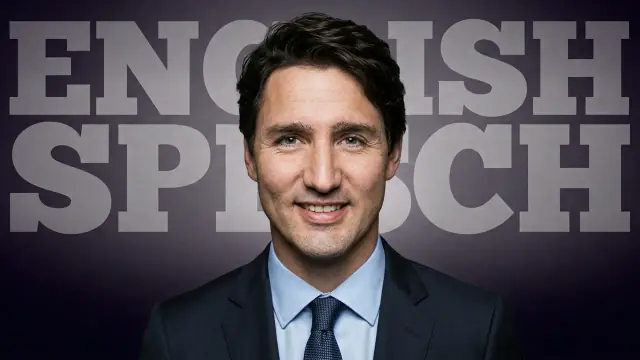
We Are Canadian
Good afternoon. Mr. President, fellow delegates, and friends, it's an honor to be with you today, and it's wonderful to be here in the great city of New York. Once again, this week, New Yorkers showed us how to be resilient and resolute in the face of violent extremism. On behalf of everybody in this room, let me say directly to the people of New York, you are a model to the world, and we thank you.
Exactly one year ago, Canada was in the middle of a long and closely fought election campaign. 78 days on the road, and I can assure you in Canada, there are 78 days worth of roads. It is the responsibility of a leader to spend time with the people they were elected to serve.
If you want the real stories, you have to go where people live. Coffee shops and church basements, mosques and synagogues, farmer's markets, public parks. It was in places like that that I got the best sense of what Canadians were thinking and how they were doing.
And through the politeness, because we Canadians are always polite, even when we're complaining I learnt a few things. I talked with people my age who were trying to be hopeful about their future, but found it tough to make ends meet even when they were working full time.
I heard from young Canadians who were frustrated, who told me that they couldn't get a job because they don't have work experience, and they can't get work experience because they don't have a job. I heard from women and girls who still face inequality in the workplace and violence just because they are women, even in a progressive country like Canada.
Who are working hard to give their children every chance in life, every chance to be successful, but who were afraid that their efforts would not be enough. I had the opportunity to share a meal with friends who are retired, who'd worked hard all of their lives, and who are now having to go to food banks. I've had too many troubling conversations with Canadians over recent years.
But they also made something clear to me. Canadians still believe in progress, or at least they believe that progress is possible. But this optimism is also mixed with a great number of concerns.
And Canadians are not the only ones to feel like this. These feelings are present everywhere. This anxiety is a reality.
When leaders are faced with citizens' anxiety, we have a choice to make. Do we exploit that anxiety or do we allay it? Exploiting it is easy, but in order to allay it, we need to be prepared to answer some very direct questions.
What will create the good, well-paying jobs that people want, and need, and deserve? What will strengthen and grow the middle class and help those working hard to join it? What will build an economy that works for everyone?
What will help to make the world a safer, more peaceful place? To allay people's anxiety, we need to create economic growth that is broadly shared because a fair and successful world is a peaceful one. We need to focus on what brings us together, not on what divides us.
For Canada, that means reengaging in global affairs through institutions like the United Nations. It doesn't serve our interests or the world's to pretend we're not deeply affected by what happens beyond our borders. Earlier on this year, we helped to negotiate the Paris climate change agreement.
And we're committed to implementing it, and we announced that Canada will invest 2.65 million dollars over five years to finance clean growth with low carbon emissions in developing countries. With a view to helping to promote peace and security in those zones which are affected by instability, we have reasserted our support for NATO, and we have committed ourselves to increasing Canada's role within the peacekeeping operations of the United Nations.
And we have hosted the fifth conference of the world. The reconstitution of the world's funds, where we increased by 5% our contribution to this fund. And we've also helped our partners to increase their contributions to the global funds, which has allowed us to amass some 13 billion dollars to eliminate AIDS, tuberculosis, and malaria by 2030.
We've done all this and will do much more because we believe we should confront anxiety with a clear plan to deal with its root causes. And we believe we should bring people together around shared purposes like the UN Sustainable Development Goals. Because what is the alternative?
To exploit anxiety? To turn it into fear and blame? To reject others because they look or speak or pray differently than we do? You see, in Canada, we got a very important thing right.
Not perfect, but right. In Canada, we see diversity as a source of strength, not weakness. Our country is strong not in spite of our differences, but because of them.
And make no mistake, we've had many failures, from the internment of Ukrainian, Japanese, and Italian Canadians during the World Wars, to our turning away of boats of Jewish and Punjabi refugees, to the shamefully continuing marginalization of Indigenous peoples. What matters is that we learn from our mistakes and recommit ourselves to doing better.
To that end, in recent months, Canadians have opened their hearts and their arms to families fleeing the ongoing conflict in Syria, and from the moment they arrived, those 31,000 refugees were welcomed not as burdens, but as neighbors and friends, as new Canadians. This effort has brought together Canadians in an almost unprecedented way.
The government has been working with business people, with committed citizens, with civil society to assist the new people coming to our country to adapt themselves to their new country. But our efforts will only be successful once these refugees have been well established as full members of the Canadian middle class.
And I want you to know that this objective is one which is within our grasp, not because of what we have done, but because of what these people are bringing themselves. You see, refugees are people with the same hopes and dreams as our own citizens. But while our people have felt anxiety, Syrians faced catastrophe.
Do you want to know where the Syrian middle class is? Well, they're living in refugee camps in Turkey, Lebanon, and Jordan. They're moving across Europe looking for a place to set down roots, to get their kids back into school, to find steady work, and to become productive citizens.
Refugee camps are teeming with Syria's middle class, doctors and lawyers, teachers and entrepreneurs. They're well-educated. They work hard. They care about their families.
They want a better life, a safer and more secure future for their kids, as we all do. So when I say that I hope that Syrian refugees will be. That we welcomed will be soon able to join our middle class, I'm confident that we can make that happen, and we'll do it by offering them the same things we offer to all our citizens, a real and fair chance at success for everyone.
We are going to do everything to build a strong middle class in Canada. We are going to invest in education because that will give the coming generations the necessary tools to make a contribution to the global economy and to be successful.
We're going to invest in infrastructure because that will create good jobs which are well paid for the middle class, and that will contribute to making our community one of the best places to live and work and invest. We are determined to build an economy which works for everyone, not only for the richest 1%, so that each and every person can benefit from economic growth.
And we are going to refuse to give in to pressure to change our profound, innermost values to win easy votes. People in the world expect more from us, and we expect more of ourselves. In the end, my friends, there is a choice to be made.
Strong, diverse, resilient countries like Canada didn't happen by accident, and they won't continue without effort. Every single day, we need to choose hope over fear, diversity over division. Fear has never created a a single job or fed a single family, and those who exploit it will never solve the problems that have created such anxiety.
Our citizens, the nearly seven and a half billion people we collectively serve, are better than the cynics and pessimists think they are. People want their problems solved, not exploited. Listen, Canada is a modest country.
We know we can't solve these problems alone. We know we need to do this all together. We know it will be hard work, but we're Canadian, and we're here to help.